
Easley City Directory Holdings
Published directories are only one part of the historical record for Easley. The local shelf needs a careful, item-by-item approach because PCLS has not published a verified year-by-year directory run, publisher list, or reverse-directory run online. The PCLS Historical Collection at Captain Kimberly Hampton Memorial Library is the local starting point. Its staff can confirm a title, issue year, call number, format, and whether a volume is alphabetic, address ordered, telephone based, or part of a wider regional publication.
| Collection | Years | Where Held | Access |
|---|---|---|---|
| PCLS Historical Collection directory holdings | Exact Easley titles and runs need desk verification | Captain Kimberly Hampton Memorial Library | Noncirculating local collection; ask staff for the catalog record |
| Verified Easley city-directory references | 1954 and 1966 | National Register nomination source | Online nomination PDF; confirm the underlying volumes at a repository |
| PCLS Digital Collections | 1916 local census; yearbooks from as early as 1925 | PCLS online repository | Digitized online material |
| Federal census and South Carolina county records | Federal census 1790-1950; county framework 1785-1950 | SCDAH, National Archives, and library venues | Catalog, online index, or research-room request as applicable |
Use the collection table as a coverage check, not as a promise that a person appears in every source. A directory may record a subscriber, a business, or a listed household member. The South Carolina Department of Archives and History adds county probate, land, equity-court, census, and death-record paths when the local directory shelf has a gap.
PCLS also names access venues that can extend the search after a local title has been identified. Ancestry Library Edition is available on public computers or library Wi-Fi, while HeritageQuest is available from home with a PCLS card and PIN. The library also links South Carolina Digital Library and Chronicling America. Database availability and search results do not prove that a particular Easley volume is included, so retain the catalog title, year, and repository record before treating a result as a directory source.
Easley Directory Research Desk
The PCLS Historical Collection is at Captain Kimberly Hampton Memorial Library, 304 Biltmore Road, Easley. It is noncirculating and cannot be sent through interlibrary loan, so a call, email, appointment, or visit is the practical fallback when a catalog item is not online. The history desk publishes (864) 850-7077 ext. 102 and history@pcls.fyi. For a short obituary lookup, provide a full name with month and year; readily accessible requests may take up to 72 business hours. Longer work belongs in a research appointment.
The PCLS history and genealogy service shown here identifies the local collection and its research channels.
A one-hour Book a Historian appointment is available once each month. Prepare the ancestor or subject name, dates, sources already checked, time period, and the help sought. That preparation helps staff retrieve a specific microfilm roll, newspaper run, map, or directory title instead of trying to infer a household from a broad request.
SCDAH supplies another in-person and remote route. Its Research Room is open Tuesday through Friday from 8:30 a.m. to 5 p.m., plus Saturday morning and afternoon sessions, and lists (803) 896-6104. Use its Online Records Index, Summary Guide, SCArchCat catalog, and SCERA to identify a concrete Pickens or predecessor-jurisdiction series before requesting material.
Reading an Easley City Directory Entry
A verified local reference proves that Easley city directories existed at least in 1954 and 1966, but it does not establish their publishers, page numbers, or a complete shelf. A National Register nomination reports Lanier Manufacturing Company at 112 Russell Street in the 1954 directory and at Greenville Road or SC Highway 93 in the 1966 directory. That is useful evidence of a business name, place, and issue year. It is not evidence about a private household, a spouse, an occupation, or an abbreviation convention.
| 1954 reference | Lanier Manufacturing Company, 112 Russell Street |
|---|---|
| 1966 reference | Lanier Manufacturing Company, Greenville Road / SC Highway 93 |
| Fields supported | Business name, address or road location, and directory year |
| Fields not supported | Publisher, page, residence, household details, owner mark, occupation, and abbreviation key |
For an actual household entry, copy the entry exactly and photograph the volume’s title page and key. The individual volume decides what its symbols mean. A name in a printed list is a lead that should be tested against time-matched land, census, probate, newspaper, or vital-record evidence.
- Criss-cross directory
- An address-ordered listing that can point from a street number to the person or organization printed for that issue year.
- Householder index
- A name-oriented arrangement that may identify the person listed for a household, but it is not a full census of everyone at the address.
- Abbreviation key
- The publisher’s explanation of shorthand and symbols. Read and retain the key before interpreting an entry.
Maps Behind Easley Directory Clues
Easley’s early record trail follows a railroad-to-mill city pattern. The National Register history places incorporation in 1873 after the Atlanta and Charlotte Air Line Railroad, identifies the depot area at Pendleton and Main, and dates Easley Cotton Mill to 1900 and Glenwood Cotton Mill to 1902. An old business or street clue may therefore lead to railroad, mill, newspaper, deed, or map material rather than a modern city database.
- 1873: Easley incorporated after completion of the railroad.
- 1900 and 1902: Easley Cotton Mill and Glenwood Cotton Mill opened.
- 1908: the Library of Congress issued a one-sheet Easley Sanborn fire-insurance map.
- 1954 and 1966: the National Register nomination cites the two local directory references.
Pair the 1908 Sanborn map with the 1958 Easley quadrangle when an address has changed form. Maps can help compare street geography and building footprint, while the deed’s legal description or plat remains the better anchor for continuity.
Easley Directory Census Snapshot
The PCLS repository contains a digitized local census taken on November 1, 1916. It offers a dated community snapshot, not a modern contact list or a substitute for a federal schedule. The document reports 3,744 people, 75 business houses, three large cotton mills, an oil and fertilizer enterprise, banks, schools, electric power, and a water plant. Its historic language and categories belong to the source and should not be carried into modern descriptions.
The digitized 1916 Census of Easley is a time-labeled primary source for a local-history search.
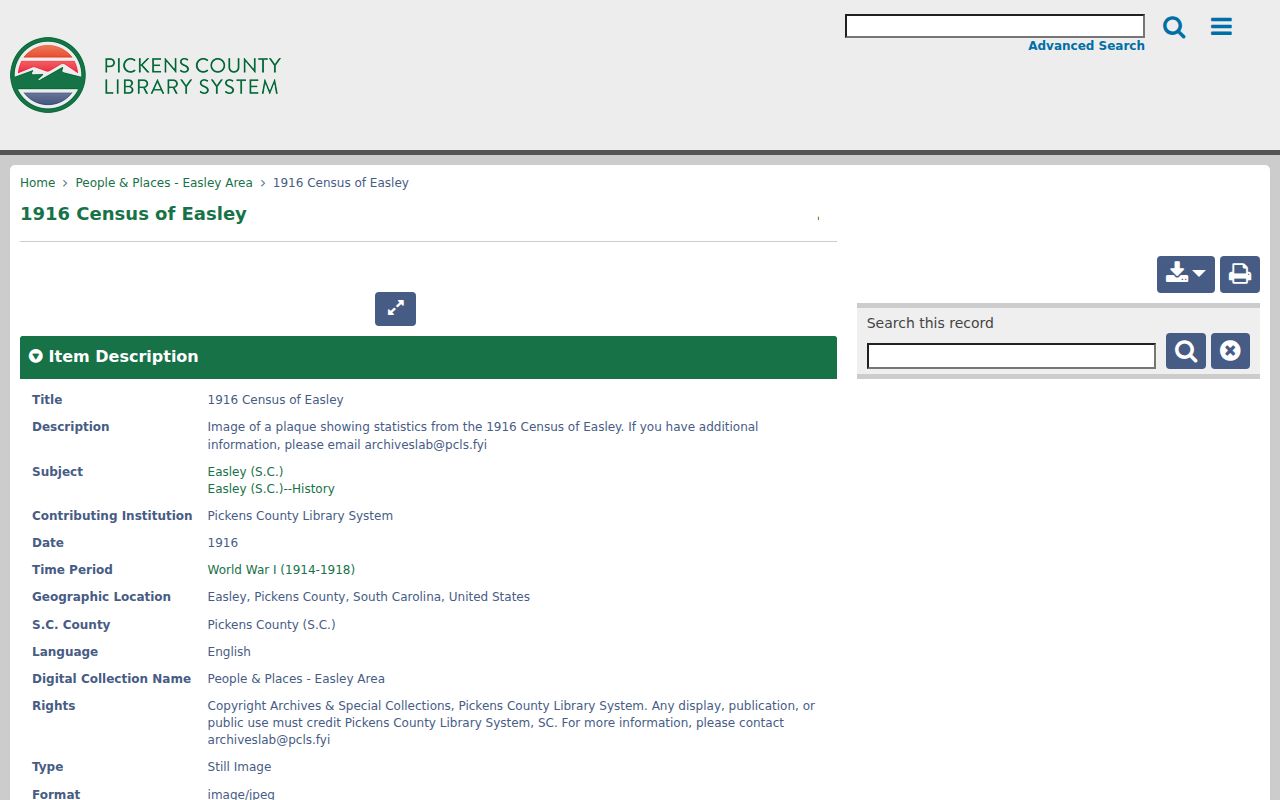
Use the census beside a directory issue only after checking the different dates and geographic scope. Federal population schedules are publicly released through 1950 under the 72-year rule, so the closest released census can test a name, age, relationship, or location without treating any single printed list as complete.
Easley Directory Newspaper Gaps
Newspapers can narrow the years between directory issues. PCLS lists the Easley Progress for 1902-1906 and 1921 through December 2016, the Pickens Sentinel from 1873 through November 2016 with a stated gap, and several Keowee, Sentinel-Progress, People’s Journal, Pickens County Courier, and Liberty Monitor runs. The University of South Carolina browse collection also identifies Pickens County titles, including the Easley Messenger for 1883-1891.
A notice can point to a business relocation, school activity, obituary, property advertisement, or street reference. Capture the title, issue date, and page, then corroborate it. PCLS also holds South Carolina death certificates from 1915-1971 and an index on microfilm for 1915-1949, which can help close a time-specific family trail under the applicable access rules.
Note: A published notice supports a dated lead, not automatic proof of legal residence or household membership.
Easley Directory Jurisdiction Names
Older Easley-area research can be filed under a jurisdiction that predates the modern county. PCLS describes Cherokee territory before 1791, Washington District in 1791, the Greenville and Pendleton split in 1798, Anderson and Pickens District in 1826, and the division into Pickens and Oconee counties in 1868. Search Pendleton District, Pickens District, Anderson, Pickens, and Oconee when an earlier name search fails.
PCLS also reports Pickens Probate wills beginning in 1828, probate marriage records beginning July 1, 1911, and South Carolina death certificates from 1915-1971 on microfilm. SCDAH’s county-record framework and the local library can then supply the appropriate catalog or microfilm fallback. Easley City File Directory material has a different modern retention cue: agendas and minutes older than 24 months are in Archives, so an older city request should ask for archived retrieval.
Trace an Easley City Directory Household
Keep the directory issue, street spelling, and role of every name together. A person can be listed as a business contact, subscriber, or one member of a household. A directory disappearance can reflect a move, death, changed listing practice, a spelling variant, or an incomplete publication. It is an evidence gap until another dated record resolves it.
- Locate the surname and given name in one verified directory issue, then save the title, page, exact spelling, address, and all printed notation.
- Check the prior and next available issue for the same address, name variants, initials, widow notation, and a possible business listing.
- Ask PCLS whether a reverse or criss-cross volume exists for that year, and record the collection title before drawing a street-level conclusion.
- Pair the interval with the closest released federal census, then compare the place and date with land, probate, obituary, newspaper, cemetery, marriage, or death evidence.
- When the address is old or unclear, compare cross streets, plats, legal descriptions, and historic maps before connecting it to a present parcel.
For a current property question, the county parcel and deed path supplies a separate record trail. Historical entries remain strongest when their limits are written down as carefully as their names and addresses.